
Is It a Leak, or Is It Your Attic?
If nothing landed on the roof, nothing came through it. A stain that appears or spreads after a cold night under a dry sky is almost always water condensing on the underside of your roof deck and dripping back down onto the ceiling, and a new covering laid over the top of that changes nothing at all.
Already know you need someone out? Call (315) 640-3590, answered 24/7.
Telling the two apart, in the order worth doing it
Date the stain against the weather
You, in about ten minutesWrite down the day it appeared or grew, then look up what fell that day. A dry day rules the covering out before anybody climbs anything.
Open the hatch and look up
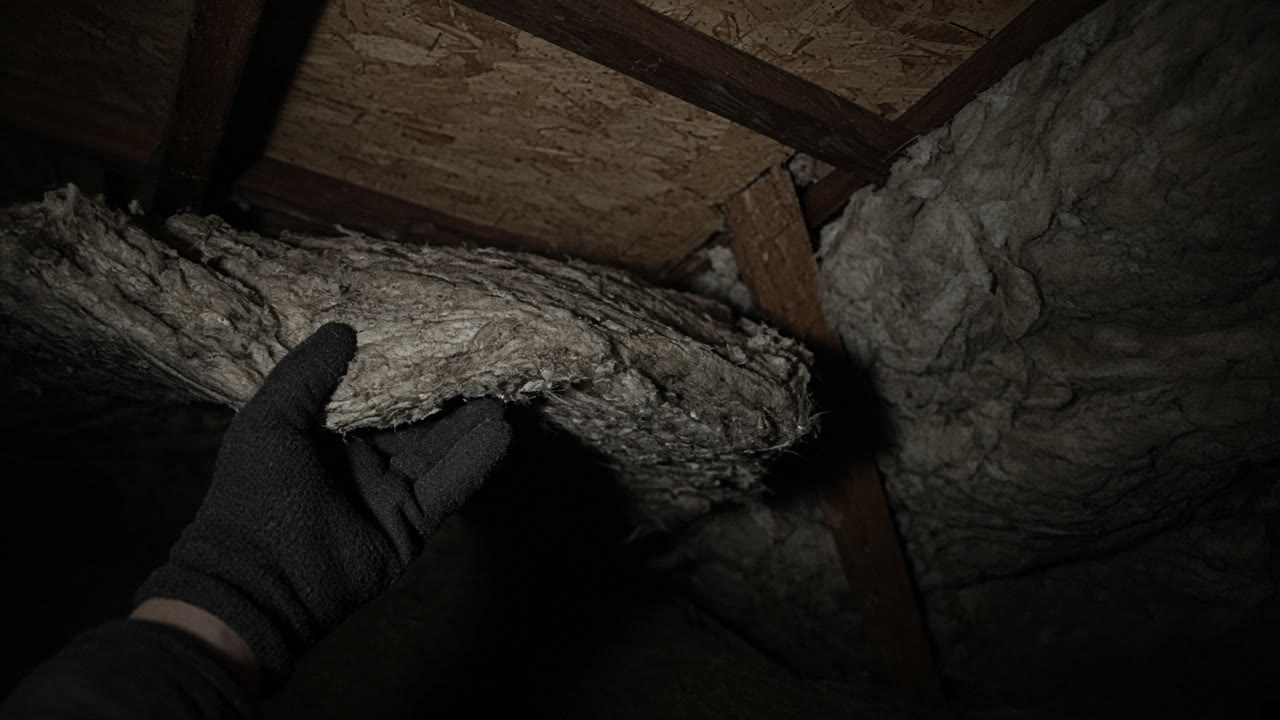
You, with a flashlight, from the ladder rather than out on the joistsFrost or dark staining on the underside of the boards, rusty nail points, damp insulation, and any flexible duct that ends in the insulation instead of going outside.
Measure instead of guessing
The contractor, on the diagnostic visitMoisture readings taken on the deck, the framing and the ceiling below, so the wet area is mapped rather than described.
Name the entry point, or rule one out
The contractor, the same visitEither water is getting past a joint on the outside, or warm indoor air is reaching the deck from the inside. Those are two different jobs.
Fix the cause, not only the stain
You, deciding, from a written proposal for the workSealing the ceiling and correcting the venting is a different bill from re-flashing a chimney, and painting over the mark is neither.
Built on the Department of Energy's Building America guidance for condensation control in cold-weather attics and on the NOAA 1991 to 2020 normals for Hancock International.
Start with what the sky was doing on the day it appeared
Before anyone goes up a ladder, work out the date the mark appeared or grew and look up what fell on the house that day. This is the part of the diagnosis you can do at the kitchen table, and in this city it settles a surprising number of cases on its own. The NOAA 1991 to 2020 normals for Hancock International give a normal January 19.1 days with at least a hundredth of an inch of precipitation and only 7.2 days with a tenth of an inch or more, which leaves roughly twelve days in the month when nothing measurable lands on the roof at all, and about twenty-four when less than a tenth of an inch does. If your ceiling darkened on one of those dry days, water did not come through the covering, because there was nothing on the covering to come through. Keep the note. It is the most useful single thing you can hand a contractor at the door.
What is actually dripping on you
Cold surfaces pull water straight out of the air. The Department of Energy's Building America Solution Center puts it plainly: condensation forms on building materials when their surface temperature drops below the dew point of the air touching them, and in cold conditions it usually arrives first as frost, then turns back into liquid water when the weather warms. The same guidance calls the roof deck the principal condensing surface in a roof assembly and says that in a vented attic the deck will be cold and often below the dew point. So a cold deck is not a defect. It is how a vented attic is meant to work. What makes it a problem is the warm, humid air from inside your house that reaches it through gaps in the ceiling. That is why the stain spreads after a cold snap and fades back in a thaw, and why it looks exactly like a leak from the sofa.
Why this happens in an ordinary, well run house here
It is not a sign that anything has been neglected. Two sourced numbers show how little room a Syracuse winter leaves. The Department of Energy recommends holding indoor relative humidity between 30 and 50 percent through the heating season, which puts the dew point of the air inside a normally warm house somewhere from the high 30s up to about 50F. On the other side of the ceiling, the NOAA hourly normals put the mean December to February dew point at Hancock International at 19.3F, with January averaging 16.9F. Those two figures never meet. For roughly four months a year the underside of the deck sits below the dew point of the air your family is breathing, so whatever gets up there gives up its water on the boards. The variable you control is not the temperature of the deck. It is how much indoor air reaches it.
It does not have to be freezing outside for this to start
This is the part most people find hardest to accept, and the New York code puts a number on it. Section R806.5 of the 2025 Residential Code of New York State, setting out an alternative route for unvented roof assemblies, asks for enough insulation above the sheathing to keep the monthly average temperature of the underside of that sheathing above 45F, and it works the calculation from the mean of the three coldest months. So the threshold the code treats as safe is 45F, well above frost. For Hancock International those three months average 26.3F, about nineteen degrees under it. That is why a mild, gray, drizzle-free stretch in late November can already be producing water on your boards, and why a homeowner waiting for a hard freeze before worrying has usually had weeks of it.
What to look for from the top of the attic ladder
You do not need to walk the attic, and you should not: put your head and a flashlight through the hatch and look. Frost or dark staining on the underside of the boards, bright rust on the points of the roofing nails, insulation matted down or damp in patches, and whether daylight reaches over the top of the outside walls. Then look for a flexible duct. The Department of Energy is explicit that a bathroom exhaust fan must discharge outdoors and never into an attic, crawlspace, garage or wall cavity, and a duct that simply ends in the insulation is a measured delivery of warm shower air onto the coldest surface in the house, every single day. The same guidance notes that an open vented attic insulated at the floor is the easiest kind to diagnose, because the decking is right there to be looked at.
The stain that runs in a stripe a foot in from an outside wall
Shape tells you something. Water that came through a joint usually makes a blot, roughly round, sometimes with a tail where it ran along a framing member. A stripe running parallel to an outside wall, a foot or two inside it, is a different animal. The Department of Energy notes that where the roof meets the wall the insulation is often compressed or simply too shallow, because standard trusses are narrow there, and that in winter this produces cold spots along the ceiling with condensation following. That band of ceiling is colder than the rest of the room, so it wets itself out of the indoor air the way a cold glass does on a summer table. The correction for it is inside the attic, over the top of the wall, and no work on the covering above will touch it.
What points the other way, to water that really did come through
Plenty of stains are leaks, and the pattern is usually clear once you know to look for it. Water that arrives during or shortly after rain, tracks to one fixed spot every time, and stops in a dry spell is coming in from outside. Section R903.2.1 of the 2025 Residential Code of New York State names the places it gets in: wall and roof intersections, any change in roof slope or direction, around openings, and the point where the eave of a sloped roof runs into a vertical sidewall. That list is short, and it is more or less the list of chronic leaks in this county. The scale matters too, because the NOAA normals record 173.6 days a year with measurable precipitation but only 5.3 days with an inch or more. A joint can cope with the small days for years and let go on the big ones.
The same drip in July, over by the air handler
Condensation is not only a winter fault, and the summer version gets misread even more often, usually as a roof leak that turned up in perfect weather. The NOAA hourly normals put the mean July dew point here at 60.7F and the mean August dew point at 59.8F, with a highest hourly July normal of 62.9F. Anything in the building held below roughly 61F through July is condensing water out of ordinary outdoor air, and in an attic the cold things in high summer are the cooling ductwork and the air handler. A ceiling mark that shows up in a heatwave, near or under attic mechanical equipment, is usually sweating metal or bare duct rather than the roof. It is still worth chasing, because the water ends up in the same place, but it is a different repair and a cheaper one.
Why a slow winter drip is worse than one storm leak
People wait on condensation because it looks minor, and that is the wrong instinct for this particular problem. The Environmental Protection Agency's guidance on moisture is that items dried within 24 to 48 hours will in most cases not become moldy, which sets the clock: a single storm leak that soaked a ceiling and then dried out is often nothing, while a slow drip that rewets the same insulation on every cold night never gets its two days. The deck material decides the rest. The Department of Energy warns that oriented strand board is more easily damaged by moisture, while solid wood and plywood can store water and dry again. A 1920s plank deck can ride out a wet winter. A 1990s strand board deck starts coming apart, and at that point the job is carpentry rather than sealing.
When you do not need to call anybody
Often you do not, and this is the honest part of the page. If the attic is dry, there is no frost on the boards and the mark has not changed in months, an old stain from something already put right is the likeliest answer, and the job is a stain-blocking primer. If the attic is damp, the first lever is yours and it is cheap: the Department of Energy's recommended heating-season band is 30 to 50 percent relative humidity, and a hygrometer plus a bath fan that actually runs long enough moves more water than most people expect. Where it is worth having someone out is when you cannot see the deck, when the wet area needs measuring rather than describing, or when there is no hatch at all. Section R807.1 of the 2025 Residential Code of New York State requires one where an attic runs 30 inches high over 30 square feet, and where there is none, nobody has ever looked. What we come out and do is find where the water is getting in, name it, and put the repair in writing.
Sources used in this guide
The NOAA 1991 to 2020 monthly normals for Hancock International give January 19.1 days with at least a hundredth of an inch of precipitation and only 7.2 days with a tenth of an inch or more. February runs 16.0 days and 6.3 days. So in a normal January about twelve days record no measurable precipitation at all and about twenty-four record less than a tenth of an inch.
Source: NOAA National Centers for Environmental Information, accessed 2026-09-14
The Department of Energy's Building America Solution Center states that condensation occurs on building materials when their surface temperatures drop below the dew point of the air they are exposed to, and that in cold conditions that condensation often forms first as frost, which returns to liquid water when warmer weather arrives.
Source: US Department of Energy, Building America Solution Center, Pacific Northwest National Laboratory, accessed 2026-09-14
The Building America Solution Center calls the roof deck the principal condensing surface in a roof assembly, and states plainly that in a vented attic the roof deck will be cold and often below the dew point, so the two primary controls are limiting air leakage from the house into the attic and providing proper intake and exhaust ventilation.
Source: US Department of Energy, Building America Solution Center, Pacific Northwest National Laboratory, accessed 2026-09-14
Put together, two sourced numbers define the gap this site works in. The Department of Energy recommends a heating-season indoor relative humidity of 30 to 50 percent, and the NOAA 1991 to 2020 hourly normals put the Syracuse mean air temperature at 24.2F through January. A house held in the recommended band at normal room temperature has an indoor dew point in the high 30s to around 50F, while the air on the other side of the ceiling averages the mid 20s.
Source: US Department of Energy, Building America Solution Center, Pacific Northwest National Laboratory, accessed 2026-09-14
Under the NOAA 1991 to 2020 hourly climate normals for Syracuse Hancock International Airport, the mean dew point across December, January and February is 19.3F against a mean air temperature of 26.9F. Monthly mean dew point normals run 22.9F in December, 16.9F in January and 18.1F in February.
Source: NOAA National Centers for Environmental Information, accessed 2026-09-14
Section R806.5 of the 2025 Residential Code of New York State offers an alternative to its prescriptive insulation table for unvented roof assemblies: install enough rigid board or sheet insulation directly above the structural roof sheathing to keep the monthly average temperature of the underside of that sheathing above 45F. For the calculation the code assumes an interior air temperature of 68F and takes the exterior temperature as the monthly average of the three coldest months.
Source: 2025 Residential Code of New York State, via UpCodes, accessed 2026-09-14
The NOAA 1991 to 2020 monthly normals for Hancock International give mean temperatures of 29.4F in December, 23.6F in January and 25.9F in February, an average of 26.3F across the three coldest months. Normal January highs and lows are 31.5F and 15.7F.
Source: NOAA National Centers for Environmental Information, accessed 2026-09-14
The Department of Energy guide requires that a bathroom exhaust fan be ducted to discharge outdoors and not into an attic, crawlspace, garage, interstitial floor space or wall cavity, that the first three feet of duct leaving the fan be straight, that joints be sealed, that the duct be insulated to limit condensation, and that where the housing sits in an attic it be covered with an airtight insulated box sealed to the ceiling drywall.
Source: US Department of Energy, Building America Solution Center, Pacific Northwest National Laboratory, accessed 2026-09-14
The Department of Energy guide observes that a vented attic insulated at the attic floor makes it easier to find and solve roof leaks and other moisture problems, because the exposed and ventilated rafters and decking can dry out more readily and the underside of the deck is relatively easy to look at, compared with an assembly where the deck is encased in spray foam or sandwiched in a cathedral ceiling.
Source: US Department of Energy, Building America Solution Center, Pacific Northwest National Laboratory, accessed 2026-09-14
The Department of Energy guide notes that at attic eaves the insulation is often compressed or insufficient because standard roof trusses are narrow there, and that in winter this causes cold spots along ceilings with consequent condensation concerns.
Source: US Department of Energy, Building America Solution Center, Pacific Northwest National Laboratory, accessed 2026-09-14
Section R903.2.1 of the 2025 Residential Code of New York State requires flashings at wall and roof intersections, wherever there is a change in roof slope or direction, and around roof openings, and requires a flashing to divert water away from the point where the eave of a sloped roof meets a vertical sidewall. Where the flashing is metal it must be corrosion resistant and not less than 0.019 inch thick, which is No. 26 galvanized sheet.
Source: 2025 Residential Code of New York State, via UpCodes, accessed 2026-09-14
The NOAA 1991 to 2020 normals for Hancock International put annual precipitation at 38.47 inches, with 173.6 days a year recording at least a hundredth of an inch, 89.7 days at least a tenth, 22.7 days at least half an inch and 5.3 days an inch or more, plus an annual snowfall normal of 123.8 inches.
Source: NOAA National Centers for Environmental Information, accessed 2026-09-14
The NOAA 1991 to 2020 hourly normals for Hancock International put the mean July dew point at 60.7F and the mean August dew point at 59.8F, with June at 55.9F. The highest hourly July dew point normal is 62.9F.
Source: NOAA National Centers for Environmental Information, accessed 2026-09-14
The Environmental Protection Agency's mold course states that it is important to dry items quickly to prevent mold growth and that in most cases items dried within 24 to 48 hours will not become moldy.
Source: US Environmental Protection Agency, accessed 2026-09-14
The Department of Energy guide advises using roof assembly materials that can safely store water, naming solid wood, treated cellulose and plywood, and warns that oriented strand board is more easily damaged by moisture while fiberglass and foams have little or no moisture storage capacity and can concentrate moisture on more sensitive materials in the assembly.
Source: US Department of Energy, Building America Solution Center, Pacific Northwest National Laboratory, accessed 2026-09-14
The Department of Energy guide reports that most sources recommend an indoor relative humidity of between 30 and 50 percent during the heating season, because lowering indoor humidity lowers the dew point and so makes condensation less likely and reduces how much water is deposited when it does happen.
Source: US Department of Energy, Building America Solution Center, Pacific Northwest National Laboratory, accessed 2026-09-14
Section R807.1 of the 2025 Residential Code of New York State requires an attic access opening where an attic with combustible ceiling or roof construction has a vertical height of 30 inches or more over an area of not less than 30 square feet, with a rough-framed opening of not less than 22 inches by 30 inches in a hallway or other readily accessible location.
Source: 2025 Residential Code of New York State, via UpCodes, accessed 2026-09-14
The Environmental Protection Agency notes that some moisture problems are not easy to see, names pipe chases and utility tunnels as common sites of hidden growth, and describes moisture meters, which read the moisture content of building materials through a probe or against the surface, as the usual way investigators locate hidden wet areas.
Source: US Environmental Protection Agency, accessed 2026-09-14
Services this guide relates to
Need someone to look at it?
Send the details and we will come back to you.