Onondaga County
Roof Penetration and Leak Diagnosis in Camillus
A Camillus roof that starts dripping beside a vent pipe has not worn out, it has one joint that failed while the covering all around it is still sound. 59.9 percent of the town's 11,481 homes were built between 1950 and 1979, the tightest single-generation concentration in the county, so whole streets here arrive at that point together and a finding on one house is worth checking on the next.
Request a quote in Camillus
Share a few details so we can confirm coverage and arrange the right next step.
Would you rather talk it through? Call (315) 640-3590, answered 24/7.
$100 off your first job
Credited by us on your first booked job.
- One credit per customer per property, on your first booked job.
- Valid through December 31, 2026.
Mention this offer when you book. Full terms.
What 59.9 percent built in one generation means here
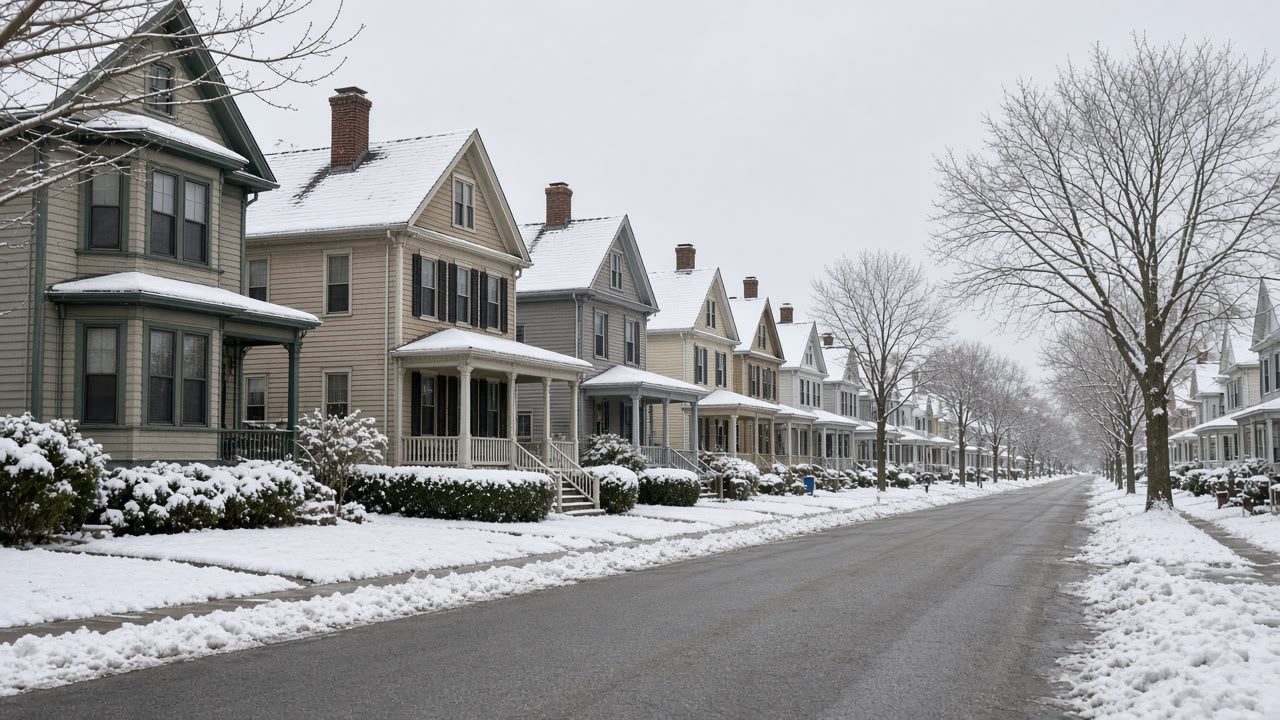
The Town of Camillus has 11,481 housing units of which 78.7 percent are single-family detached, with 79.4 percent owner occupancy. 59.9 percent of the town's housing was built between 1950 and 1979 and 69.1 percent before 1980. Camillus village inside it is much older, a median build year of 1958 with 32.2 percent of its units built in 1939 or earlier and only 44.2 percent detached.
Source: US Census Bureau, American Community Survey 2020-2024 5-year estimates, tables B25034 year structure built, B25035 median year structure built, B25024 units in structure and B25003 tenure, accessed 2026-09-14
In the Town of Camillus the median year of construction is 1966. Of 11,481 housing units, 6.1 percent were built in 1939 or earlier, 9.2 percent before 1950, 69.1 percent before 1980 and 30.9 percent in 1980 or later. 78.7 percent are single-family detached and 79.4 percent of occupied units are owner occupied.
Source: US Census Bureau, American Community Survey 2020-2024 5-year estimates, tables B25034 year structure built, B25035 median year structure built, B25024 units in structure and B25003 tenure, accessed 2026-09-14
Section R905.2.8.4 of the 2025 Residential Code of New York State does not set dimensions for soil stack, vent pipe and chimney flashing. It requires instead that they be applied in accordance with the asphalt shingle manufacturer's printed instructions, and R905.2.8 makes the whole flashing section subject to those instructions.
Source: 2025 Residential Code of New York State, via UpCodes, accessed 2026-09-14
No primary source was found for the service life of a plumbing vent pipe boot or its rubber collar. Section R905.2.8.4 of the 2025 Residential Code of New York State defers pipe flashing entirely to the shingle manufacturer's printed instructions and states no durability figure, and no federal or state publication reviewed gives one.
Source: 2025 Residential Code of New York State, via UpCodes, accessed 2026-09-14
Section R903.2.1 of the 2025 Residential Code of New York State requires flashings at wall and roof intersections, wherever there is a change in roof slope or direction, and around roof openings, and requires a flashing to divert water away from the point where the eave of a sloped roof meets a vertical sidewall. Where the flashing is metal it must be corrosion resistant and not less than 0.019 inch thick, which is No. 26 galvanized sheet.
Source: 2025 Residential Code of New York State, via UpCodes, accessed 2026-09-14
Dripping beside a vent pipe?
Send the Camillus address and roughly where in the room it lands. We will arrange a visit that starts at the joints.
Why Camillus roofs let go at the pipes, not the field
At the penetrations the New York code does something unusual: it sets no dimensions at all for soil stack, vent pipe and chimney flashing, and requires instead that they be applied in accordance with the asphalt shingle manufacturer's printed instructions, with the whole flashing section made subject to those instructions. That has two consequences worth knowing before you accept a quote. The first is that you are entitled to ask which product is on your roof and what its instructions require, because that document is the standard the work is measured against. The second is that no rule of thumb about how long a boot lasts is a code rule, and we will not hand you one: there is no primary source anywhere for the service life of a pipe boot or its rubber collar, so the argument is made from what is visible on the roof and from the way the code is built, never from a number of years. Camillus is where this gets practical. 59.9 percent of the town's housing went up between 1950 and 1979 and 69.1 percent of it before 1980, with 78.7 percent single-family detached, which means near-identical roof geometry in long runs and details that were all done the same way at the same time. Camillus village inside the town is a different stock, a 1958 median with 32.2 percent built before 1940 and only 44.2 percent detached, so we say which of the two we mean.
Flashing and penetration work we arrange in Camillus
Roof and Attic Leak Diagnosis
Find out where the water is actually getting in before anyone prices a covering, including whether it came through the roof at all.
Leak Diagnosis in Camillus →Flat and Low-Slope Roofing
Find out whether a nearly flat porch, addition or garage roof leaks because it has the wrong covering on it, and what may lawfully go up there instead.
Low-Slope Roofing in Camillus →Flashing, Chimney and Skylight Repair
Rebuild the joint the water is actually using, at a chimney, wall, valley, vent or skylight, without re-covering a roof that is still doing its job.
Flashing Repair in Camillus →Gutters, Downspouts and Roof Drainage
Get the water that leaves the roof away from the house properly, instead of over the gutter, behind the fascia or straight down the foundation wall.
Gutters and Drainage in Camillus →Attic Ventilation and Air Sealing
Stop indoor air reaching the cold roof deck, and get the vent area and the vent split right, so the attic stops making its own water.
Attic Ventilation in Camillus →Tell us which Camillus joint is letting water in
Chimney, vent pipe, skylight, valley, or a corner where the roof meets a wall. Name the spot and we will tell you what the repair involves.