
Syracuse and the surrounding Onondaga County area
Gutters, Downspouts and Roof Drainage in Syracuse
Get the water that leaves the roof away from the house properly, instead of over the gutter, behind the fascia or straight down the foundation wall.
Gutters and Drainage quote
Tell us where it overflows and where the downspouts end up, and we will put you in front of insured contractors who look at the fall and the discharge before quoting a new run. If an extension at the bottom is the answer, you will be told that.
Would you rather talk it through? Call (315) 640-3590, answered 24/7.
$100 off your first job
Credited by us on your first booked job.
- One credit per customer per property, on your first booked job.
- Valid through December 31, 2026.
Mention this offer when you book. Full terms.
What actually goes wrong with gutters here
Water coming off a roof has to go somewhere, and when it goes over the front of a gutter in the same spot every storm, or down the wall from a downspout that stops at the ground, it starts working on things that cost far more than gutters do. Soft fascia, a stained soffit, a damp basement wall and a strip of permanently wet ground by the steps are one fault seen in four places. Two numbers out of federal guidance settle most of it. Gutters want a fall of at least 1/16 inch per foot of run toward the downspouts, which is about an inch over sixteen feet, and downspouts should finish at least 5 feet from the foundation, or discharge to an underground catchment at least 10 feet out that is not tied into the foundation drain. A great deal of what gets called a gutter problem is a discharge problem, and a length of extension is not roof work at all.
- Re-hanging and re-pitching a run that has lost its fall, which is why it overflows in one place
- Sectional and seamless gutter replacement in the 4, 5 and 6 inch channel sizes
- Downspout repair, resizing and re-routing, including adding an outlet to a long run
- Extensions, splash blocks and buried catchment so the discharge lands away from the foundation
- Fascia and soffit repair where the board behind the gutter has gone soft
- Drip edge at the eave, which decides whether water reaches the channel or the board
- Leaf guards and screens, with an honest account of what they do and do not stop
- Clearing and flushing runs, outlets and buried leaders nobody has seen in years
- Hanger and bracket work on a roof edge that carries an ice load every winter
- Roof drains, scuppers and the secondary overflow a low-slope section with a raised edge has to have
- Grade-level drainage as the alternative on a short or awkward run that freezes solid year after year
- Outlet capacity where one gutter takes the water off several roof planes at once
What decides a gutter and drainage job
Most of this is decided by where the water arrives and where it is supposed to leave, not by the length of the run. These are the things that move it, and you can check the first two yourself in one downpour.
Whether the run has any fall left in it
Overflowing in one spot is what a gutter does when it has stopped sloping, not what a gutter does when it is too small. The Department of Energy puts the minimum at a slope of at least 1/16 inch per foot of run toward the downspouts to give positive drainage, which is about an inch over sixteen feet and is checkable with a string line. Re-hanging a run to restore that is a fraction of the price of replacing it, so it is the first thing worth establishing.
Where the downspout puts the water
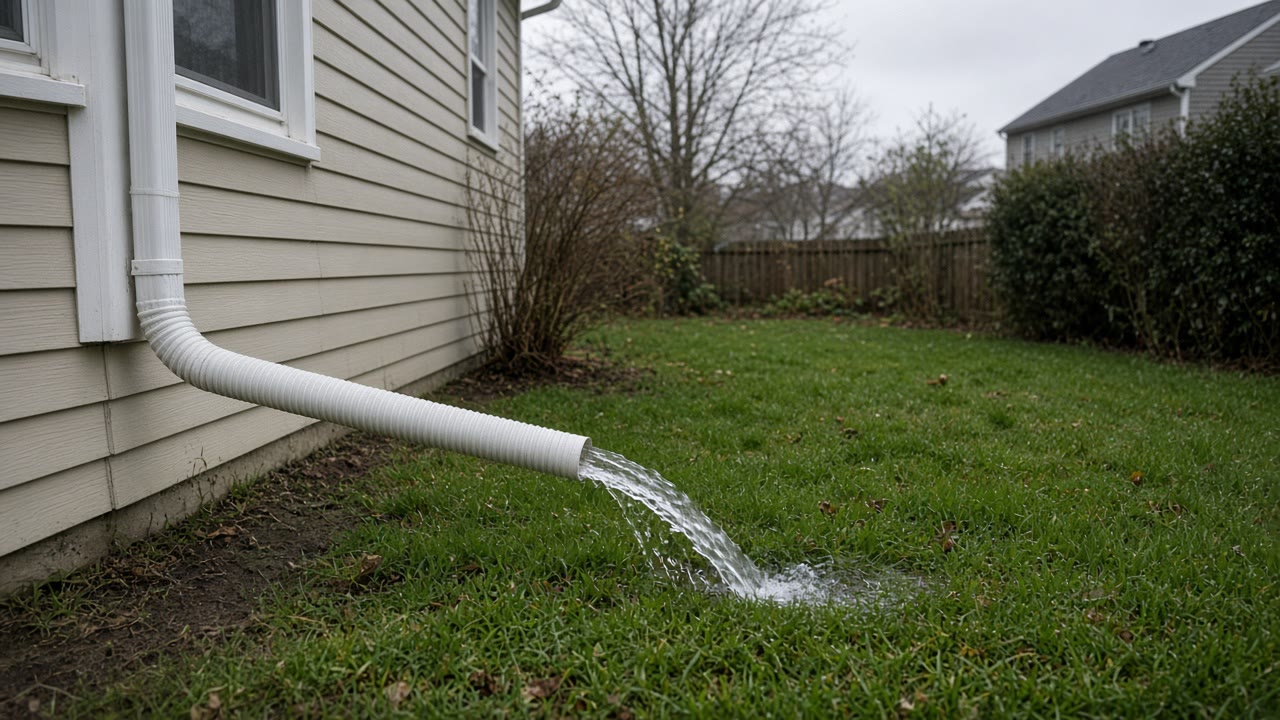
This is the cheapest correction in the trade and the one skipped most often. The Department of Energy directs that downspouts terminate at least 5 feet from the foundation, or discharge to an underground catchment at least 10 feet from the foundation that is not connected to the foundation drain system. A downspout ending at the wall is a wet basement wearing a roof problem's clothes, and it is corrected with a length of extension rather than with roof work.
How much water the run actually has to carry
Capacity is set by the roof above, not by the wall the gutter is screwed to. The NOAA 1991 to 2020 normals for Hancock International put annual precipitation at 38.47 inches, with 89.7 days a year at a tenth of an inch or more, 22.7 days at half an inch and 5.3 days at an inch or more. A run and a single outlet that cope with a tenth of an inch are not necessarily coping on those five days, and where one gutter drains two or three planes the number of outlets matters more than the size of the channel.
What the fascia behind it is like
The board is usually the real bill. Water running behind a gutter rather than into it wets the fascia and the edge of the soffit over and over, and the Environmental Protection Agency's guidance is that items dried within 24 to 48 hours will in most cases escape mold, which a board wet after every shower never gets the chance to do. Whether those boards are sound decides whether this is a hanging job or a carpentry job, and it is established with the gutter down.
Whether the roof edge is delivering to the channel at all
The transition from the covering to the gutter is a detail, not a gap. Where there is no drip edge, or the underlayment runs the wrong way over it at the eave, water clings back under the edge of the covering and onto the board instead of dropping into the channel. That is why a brand new gutter can still hand you a rotten fascia in five years, and it is also why some of this work belongs to the day a covering comes off.
Whether this particular run freezes every winter
There is federal guidance that cuts against the local default, and it is worth knowing before paying for a fourth set of gutters on the same eave. The Department of Energy states that in cold climates gutters will freeze and should be avoided, and that grade-level drainage should be installed instead: a rock bed over a lined trench with a drain pipe carrying water to a finished grade at least 5 feet from the foundation, a dry well or another approved location, with the house protected from splashback. That is written for new construction, so read it as a per run option rather than an instruction to take down gutters that work. On a short, awkward, repeatedly ice-bound section it is a real answer and an accepted one.
Whether a low-slope section drains into the same system
A shallow roof behind a parapet or a raised edge is a different problem from an eave. Section R903.4 of the 2025 Residential Code of New York State requires roof drains at each low point unless the roof is sloped to drain over its edges, and R903.4.1 requires a secondary emergency overflow drain or scupper, with the overflow inlet set 2 inches above the low point, where the perimeter would trap water if the primary drain blocked. One outlet and no overflow up there is the thing to correct first, because that failure is structural and not just wet.
What the housing around the gutter is like
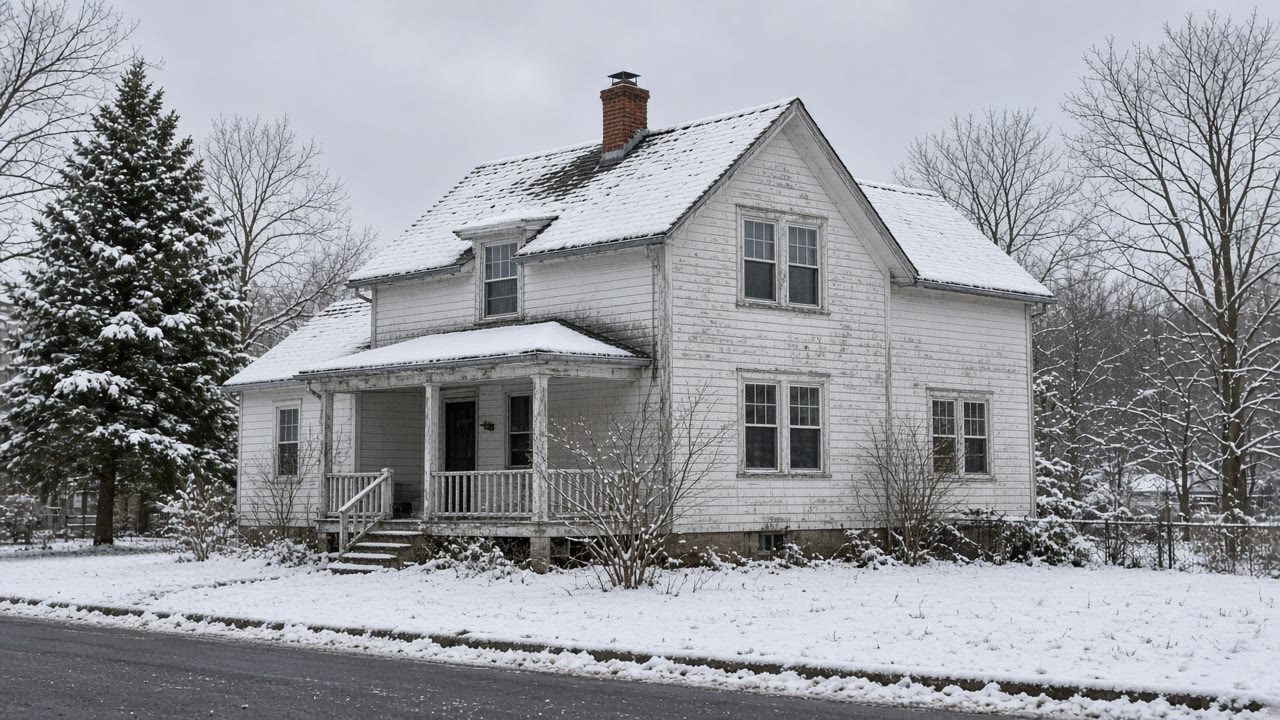
This work on a 1938 village house with open eaves and a deep overhang is not the same job as on a trussed house from the 1980s with a shallow soffit, and this metro holds both. Median year of construction across the places on this site runs from 1938 in East Syracuse, Liverpool, Skaneateles, Jordan and Fabius villages up to 1985 in the Town of Lysander, with the county sitting at 1964. Hanger type, fascia detail and access all change across that spread.
Overflowing in one spot, or everywhere at once?
Those are two different faults and only one of them needs new gutters.
How drainage work gets sorted out
Point at the spot where it goes over
One place every storm is a fall problem or a blocked outlet. Everywhere at once is capacity or a buried leader. Behind the boards rather than over the front is the roof edge detail. Those three send completely different work, and you can tell them apart in a single downpour with an umbrella.
Walk the discharge before anything else
Follow each downspout to where it ends: at the wall, into a splash block sitting against the foundation, into a buried line nobody has seen for twenty years, or out to daylight. Five feet from the foundation is the figure to compare it against, and this walk regularly ends the whole job for the price of two extensions.
String the run and find the fall
A line along the front edge shows whether the gutter still slopes toward the outlet or has settled into a dip. About an inch over sixteen feet is what is being looked for. A run that has lost it gets re-hung. A run that is deformed, split at the seams or pulled off its hangers gets replaced.
Look at the boards while the gutter is down
Fascia and the edge of the soffit are the reason to do this properly, and they can only be seen with the channel off. Soft board gets replaced before new gutter goes onto it, because a new gutter hung on rotten wood is a repair with a deadline on it.
Size the outlets to the roof, not to the wall
How many downspouts a run needs is set by the area draining into it. Channels come in 4, 5 and 6 inch sizes, and the style, K or half round, is appearance rather than a performance difference. Adding an outlet to a long run is often more effective than a bigger channel and costs less than replacing the run.
Take the water properly away from the house
Extensions, a buried catchment carried well out past the foundation, or a grade-level bed on a run that ices up every year. What it is not connected to is the foundation drain system, because that delivers the roof's water back to the wall by a longer route.
Deal with the low-slope section separately
Where a flat roof drains into the same system, its drains, scuppers and secondary overflow are their own piece of work with their own requirements, and they are handled as roof drainage rather than as gutters.
What gutters and drainage looks like

What drainage work covers
When you may not need this at all
- If a downspout empties at the wall, buy an extension before you book anybody. The federal figure is at least 5 feet from the foundation, and that one change accounts for a surprising share of wet basement walls for the price of a length of pipe.
- If the gutters cope with ordinary rain and only overflow in a downpour, they may be the wrong capacity rather than faulty, and the answer is another outlet rather than a new run.
- If the only symptom is icicles and nothing is wet inside, there may be nothing to do here. Icicles mean snow is melting; they are not in themselves proof that water is getting anywhere it should not be.
- If a run freezes solid every single winter and has been replaced more than once, ask about grade-level drainage instead. The Department of Energy says outright that gutters freeze in cold climates and describes a rock bed over a drain pipe to a point at least 5 feet from the foundation as the alternative. It is a per run decision and it does not mean taking down gutters that are working.
- If the water is arriving on a ceiling rather than on the ground, this is not your service. Overflowing gutters wet walls, soffits and foundations; a mark in the middle of a ceiling is a leak or a condensation question and starts with a diagnosis.
- Clearing a single story run is a homeowner job in dry weather, and paying somebody for it is a convenience rather than a repair.
What is out of scope
- Basement waterproofing, sump pumps, interior drain tile and foundation crack repair. Getting the roof water away from the wall is this work; what is already inside is not.
- Yard grading, landscaping and site drainage beyond the discharge point of the downspouts.
- Storm and sanitary sewer work, and any connection into a municipal system.
- Heat cables and roof de-icing systems sold as a substitute for dealing with the cause.
- Siding, trim and painting beyond the fascia and soffit that have to come off to do the work.
- Snow and ice removal from a roof or a gutter as a seasonal service.
- Insurance paperwork of any kind.
Towns where we arrange gutter and drainage work
- Gutters and Drainage in Syracuse
- Gutters and Drainage in East Syracuse
- Gutters and Drainage in Clay
- Gutters and Drainage in Cicero
- Gutters and Drainage in DeWitt
- Gutters and Drainage in North Syracuse
- Gutters and Drainage in Salina
- Gutters and Drainage in Liverpool
- Gutters and Drainage in Camillus
- Gutters and Drainage in Geddes
- Gutters and Drainage in Solvay
- Gutters and Drainage in Manlius
- Gutters and Drainage in Fayetteville
- Gutters and Drainage in Skaneateles
- Gutters and Drainage in Elbridge
- Gutters and Drainage in Pompey
What people ask about gutters and where the water goes
My gutters overflow in the same spot every time. Do I need new ones?
Usually not. Going over in one place is what a gutter does when it has lost its fall, or when the outlet below it is blocked, and both cost far less than replacement. The Department of Energy's figure for positive drainage is a slope of at least 1/16 inch per foot of run toward the downspouts, which is about an inch over sixteen feet, so a string line along the front edge will tell you whether the run still has it. Replacement is the right answer when the channel is split at the seams, deformed by ice, or hanging off a fascia board that has gone soft, and those are findings rather than assumptions.
Water is getting into my basement. Is that a roof problem?
It is worth ruling out before anyone starts digging, because the cheapest possible answer lives here. A roof sheds a lot of water: the NOAA 1991 to 2020 normals put Syracuse at 38.47 inches of precipitation a year with 22.7 days over half an inch, and all of it lands on the roof and leaves through the downspouts. If one of those ends at the wall, it is delivering to the foundation on purpose. The Department of Energy asks for a termination at least 5 feet out, or a buried catchment at least 10 feet out that is not connected to the foundation drain system. Extensions cost very little and it is a fair first experiment before a bigger one.
Are leaf guards worth it?
They change the maintenance rather than remove it. A screen or a guard keeps whole leaves and the worst of the debris out of the channel, which matters most on a run under trees that nobody can reach safely. What they do not do is correct a run with no fall, a blocked buried leader, or a downspout discharging at the wall, and a guard fitted over any of those hides it instead. The order that makes sense is fall first, discharge second, capacity third, guards last.
Should I have gutters at all, or is there something better?
For most houses gutters are the right answer, and the reason to ask the question is specific: a run that freezes solid every winter. The Department of Energy states that in cold climates gutters will freeze and should be avoided, and that grade-level drainage systems should be installed instead, describing a rock bed around the house over a lined trench with a drain pipe carrying water to a finished grade at least 5 feet from the foundation, a dry well or another approved location, with the house protected from splashback. That guidance is framed for new construction, so it should be read as a legitimate option for one run rather than as advice to strip working gutters off a house. On a short, awkward or repeatedly ice-bound section it can be the better spend.
The fascia board behind my gutter has gone soft. Is that the gutter's fault?
Often it is the detail between the covering and the gutter rather than the gutter itself. Where the roof edge has no proper drip edge, or the underlayment is lapped the wrong way there, water clings back under the edge of the covering and runs onto the board instead of falling into the channel. That wets the same strip of wood over and over, and the Environmental Protection Agency's guidance is that items dried within 24 to 48 hours will in most cases escape mold, which a board wet after every rainfall never manages. So the board gets replaced and the edge detail gets corrected, or the new board goes the same way as the old one.
The gutter pulled away from the house this winter. What now?
Get the boards behind it looked at before it goes back up. A gutter that has come away has usually been loaded by ice, and the question that decides the repair is what the hangers were fixed into. Sound fascia takes new hangers and holds them. Soft fascia does not, and re-hanging a gutter on it buys a year. While the run is down is also the moment to check the fall along it and the discharge at the bottom, because the access is already paid for and those two are what caused the standing water in the first place.
Say where the water ends up
Over the front, behind the boards, or at the foundation wall.