
Where Roofs Actually Leak
At the joints, almost always, and hardly ever in the middle of a plain run of shingles. The 2025 Residential Code of New York State names those joints in section R903.2.1: wall and roof intersections, any change in slope or direction, around openings, and the point where an eave runs into a sidewall. That short list is more or less the list of leaks in this county.
Already know you need someone out? Call (315) 640-3590, answered 24/7.
How a joint leak gets found and put right
Work back from the wet spot
The contractor, inside firstWater runs along framing before it drops, so the stain is downhill of the entry. The attic side of the ceiling usually shows the track.
Match it to a joint above
The contractor, from the roofChimney, wall junction, valley, vent pipe, skylight or a change of direction. The code list and the leak list are close to the same list.
Open the courses either side
The contractor, on the repairStep flashing and valley linings sit under the shingles, so a real correction means lifting the courses beside them, not spreading something over the top.
Rebuild the detail, lapped in the right order
The contractorEach piece lapped shingle fashion, tied into the wall drainage plane above, and the water turned out into the gutter at the bottom of the run.
Close it up and check where the water now goes
The contractor, before leavingA joint that has been fixed still has to discharge somewhere sensible, which is usually the gutter and not the wall below.
Flashing requirements from the 2025 Residential Code of New York State, sections R903.2.1, R903.2.2, R905.2.8.2, R905.2.8.3 and R905.2.8.4.
The plain field of a roof is the easy part
A run of shingles across an open slope is a simple overlapping surface with nothing to decide. The joints are where somebody had to make a decision, and where a leak nearly always turns out to be. Section R903.2.1 of the 2025 Residential Code of New York State requires flashing at wall and roof intersections, wherever there is a change in roof slope or direction, and around roof openings, and it requires a flashing to divert water away from the point where the eave of a sloped roof meets a vertical sidewall. Where that flashing is metal it must be corrosion resistant and not less than 0.019 inch thick, which is No. 26 galvanized sheet. If your roof has no trouble anywhere except one corner, the field is a distraction and the corner is the job.
The chimney test you can do with a tape measure
Chimneys are the most common chronic leak on older houses here, and there is a measurable rule about them that very few homeowners have heard. Section R903.2.2 of the 2025 Residential Code of New York State requires a cricket or saddle on the ridge side of any chimney or penetration more than 30 inches wide, measured perpendicular to the slope, built of sheet metal or of the same material as the roof covering. Unit skylights flashed to the manufacturer's instructions are excepted. So measure the chimney across the slope. If it is wider than 30 inches and there is no built-up slope on its uphill side, then snow and water are being asked to pond behind a block of masonry, every winter, and the roof loses that argument. Repointing the brickwork does not change it.
Where a roof runs into a wall, and what should be under the siding
This is the detail that most often gets bodged, and the code is specific about it. Section R905.2.8.3 of the 2025 Residential Code of New York State requires base flashing against a vertical sidewall to be continuous or step flashing, not less than 4 inches high and 4 inches wide, directing water away from the wall onto the roof or into the gutter. Where there is siding, the vertical leg has to run continuously behind that siding. Where there is anchored masonry veneer, counterflashing is required as well. What that rules out is the thing you can often see from the driveway: metal surface-nailed over the siding and smeared with roof cement. Sealant at a roof-to-wall joint is a sign that the detail was never built correctly, not a sign that somebody has been maintaining it.
The small piece of metal at the bottom of that run
There is one piece at the end of a roof-to-wall junction that decides whether the water joins the gutter or goes into the wall, and it is missing on a great many houses. The Department of Energy's flashing guidance directs that step and kick-out flashing be installed at all roof-wall intersections, that step flashing extend at least 4 inches up the wall and 4 inches out along the deck, that the pieces be lapped shingle fashion and integrated with the wall drainage plane above, that siding stop at least an inch above the roof surface, and that the kick-out at the lower end be big enough for the flow. It notes that site-made diverters are often undersized or have unsealed seams. From the ground you can check two of those yourself: is there a turned-out piece of metal at the bottom, and is there a gap under the siding.
A re-sided house can hide this for years
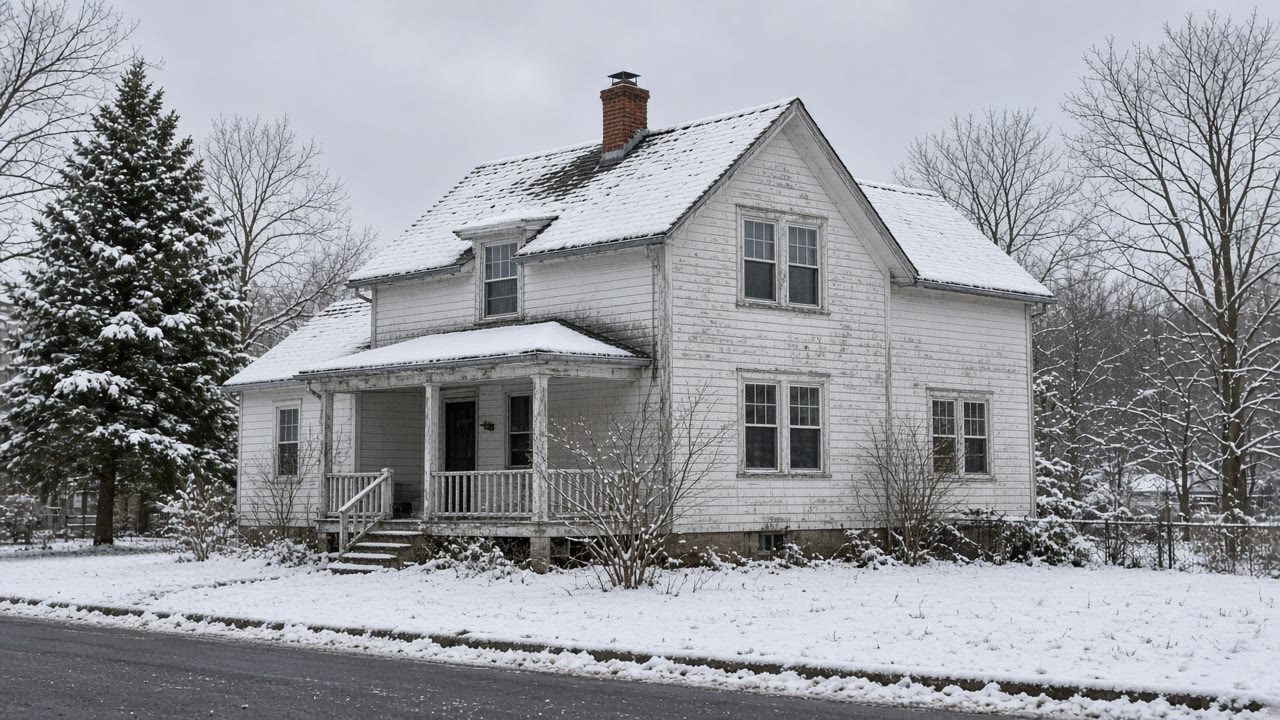
The absence of anything visible outside is not evidence that the junction is sound, and this is a specifically local trap on housing that has been modernized. The Department of Energy states that where sidewall flashing is missing or inadequate, water leaks into the wall and causes serious damage to sheathing, framing and insulation and mold in the wall cavities, and that while older wood siding used to announce the problem as peeling paint, newer claddings such as fiber cement, vinyl and brick veneer can mask the evidence for years. Re-siding is common on this county's older housing. So when a house looks tidy outside and there is a recurring damp patch on an upstairs ceiling or the top of an interior wall, the place to look is inside, below where a roof runs into a wall.
Valleys cannot honestly be repaired from the surface
A valley carries the water off two roof planes at once, so it moves more water than anything else on the house, and it is built from the bottom up. Section R905.2.8.2 of the 2025 Residential Code of New York State requires valley linings to be installed before the shingles go on, and sets minimum widths by type: metal not less than 24 inches wide for an open valley, an 18 inch bottom layer with a top layer of not less than 36 inches where two plies of mineral-surfaced roll roofing are used, and for a closed valley one ply of smooth roll roofing not less than 36 inches wide, or a self-adhering polymer-modified bitumen underlayment in its place. Because the lining goes under, a valley cannot be relined without opening the shingles either side of it. A quote promising to fix a leaking valley without disturbing the shingles is describing a surface treatment.
Vent pipes, and why nobody will give you a number of years
A fifteen year old roof that starts dripping over a bathroom while the shingles are still sound is usually leaking at a plumbing vent, and you will find a lot of confident claims online about how long the rubber collar on one lasts. We looked for a source for that and there is not one, so this page does not carry a figure. What the code does say is structural and more useful: section R905.2.8.4 of the 2025 Residential Code of New York State sets no dimensions for soil stack, vent pipe and chimney flashing at all, and instead requires them to be applied in accordance with the asphalt shingle manufacturer's printed instructions. You are therefore entitled to ask which product is on your roof and what its instructions require, and no rule of thumb about boots is a code rule.
What two months of real heat does to the small parts
Cold is the main story on a Syracuse roof, but the penetrations are where the summer matters. The NOAA 1991 to 2020 annual normals for Hancock International record 58.3 days a year with a high above 80F and 6.8 days above 90F, and no days at all reaching 100F. That is not enough heat to make the covering the problem, and it is plenty to work on the flexible parts: the rubber collars around vent pipes, the sealed seams on site-made diverters, the gaskets on mechanical vents. Those sit in full sun on a dark surface that runs far hotter than the air temperature. It is a reasonable thing to have looked at when somebody is already on the roof for another reason, and an unreasonable thing to replace a covering over.
The older the roof shape, the more joints it has
Not every house carries the same amount of risk here, and the difference is geometry rather than age on its own. Skaneateles village has the oldest housing of any place on this site by share, 54.3 percent of its 1,353 units built in 1939 or earlier and a median build year of 1938. Pre-1940 construction here means steep main roofs with dormers, valleys, direction changes and masonry chimneys, which is to say a lot of the junctions the code writes rules about, packed into one roof. A postwar ranch may have two joints on the whole house. A village house of that period can have a dozen. That is not a reason to expect trouble, it is a reason why a diagnostic visit on an old house takes longer and why a phone diagnosis is worthless on one.
What you can check yourself, and what needs somebody on the roof
From the ground with binoculars you can get a long way: look for sealant smeared at a wall junction, a missing turn-out at the bottom of one, siding sitting flat on the shingles, and a chimney wider than 30 inches with nothing on its uphill side. Any of those is worth acting on and none of them needs a ladder. What you cannot do from the ground is work out where water is traveling once it is inside, and the Environmental Protection Agency's point about hidden moisture applies squarely to roofs: some moisture problems are not easy to see, and investigators locate wet areas with a moisture meter rather than by opinion. Do not go up there yourself. What we do is trace it from the wet spot back to the joint, say which one it is, and price that repair in writing.
Sources used in this guide
Section R903.2.1 of the 2025 Residential Code of New York State requires flashings at wall and roof intersections, wherever there is a change in roof slope or direction, and around roof openings, and requires a flashing to divert water away from the point where the eave of a sloped roof meets a vertical sidewall. Where the flashing is metal it must be corrosion resistant and not less than 0.019 inch thick, which is No. 26 galvanized sheet.
Source: 2025 Residential Code of New York State, via UpCodes, accessed 2026-09-14
Section R903.2.2 of the 2025 Residential Code of New York State requires a cricket or saddle on the ridge side of any chimney or penetration more than 30 inches wide, measured perpendicular to the slope, and requires it to be sheet metal or the same material as the roof covering. Unit skylights flashed to the manufacturer's instructions are excepted.
Source: 2025 Residential Code of New York State, via UpCodes, accessed 2026-09-14
Section R905.2.8.3 of the 2025 Residential Code of New York State requires base flashing against a vertical sidewall to be continuous or step flashing, not less than 4 inches in height and 4 inches in width, and to direct water away from the wall onto the roof or into the gutter. Where there is siding, the vertical leg of the flashing must run continuously under the siding; where there is anchored masonry veneer, counterflashing is required as well.
Source: 2025 Residential Code of New York State, via UpCodes, accessed 2026-09-14
The Department of Energy guide directs that step and kick-out flashing be installed at all roof-wall intersections and boot or collar flashing at all roof penetrations, that step flashing extend at least 4 inches up the wall and 4 inches out along the roof deck, that the pieces be lapped shingle fashion and integrated with the wall drainage plane above, that siding end at least one inch above the roof surface, and that the kick-out at the lower end of the intersection be large enough for the expected flow. It notes that site-made diverters are often undersized or have unsealed seams.
Source: US Department of Energy, Building America Solution Center, Pacific Northwest National Laboratory, accessed 2026-09-14
The Department of Energy's guide on roof-wall flashing states that where sidewall flashing is missing or inadequate, water leaks into the wall and causes serious damage to sheathing, framing and insulation and mold in the wall cavities, and that while older wood siding showed the problem as peeling paint, newer claddings such as fiber cement, vinyl siding and brick veneer can mask the evidence for years.
Source: US Department of Energy, Building America Solution Center, Pacific Northwest National Laboratory, accessed 2026-09-14
Section R905.2.8.2 of the 2025 Residential Code of New York State requires valley linings to be installed before the shingles go on, and sets minimum widths by valley type: open valleys lined with metal not less than 24 inches wide, open valleys of two plies of mineral-surfaced roll roofing with an 18 inch bottom layer and a top layer not less than 36 inches, and closed valleys lined with one ply of smooth roll roofing not less than 36 inches wide, or a self-adhering polymer-modified bitumen underlayment in place of the lining.
Source: 2025 Residential Code of New York State, via UpCodes, accessed 2026-09-14
Section R905.2.8.4 of the 2025 Residential Code of New York State does not set dimensions for soil stack, vent pipe and chimney flashing. It requires instead that they be applied in accordance with the asphalt shingle manufacturer's printed instructions, and R905.2.8 makes the whole flashing section subject to those instructions.
Source: 2025 Residential Code of New York State, via UpCodes, accessed 2026-09-14
No primary source was found for the service life of a plumbing vent pipe boot or its rubber collar. Section R905.2.8.4 of the 2025 Residential Code of New York State defers pipe flashing entirely to the shingle manufacturer's printed instructions and states no durability figure, and no federal or state publication reviewed gives one.
Source: 2025 Residential Code of New York State, via UpCodes, accessed 2026-09-14
The NOAA 1991 to 2020 annual normals for Hancock International record 58.3 days a year with a high above 80F and 6.8 days above 90F, and no days at all reaching 100F.
Source: NOAA National Centers for Environmental Information, accessed 2026-09-14
In Skaneateles village the median year of construction is 1938. Of 1,353 housing units, 54.3 percent were built in 1939 or earlier, 61.2 percent before 1950, 82.5 percent before 1980 and 17.5 percent in 1980 or later. 73.0 percent are single-family detached and 75.5 percent of occupied units are owner occupied.
Source: US Census Bureau, American Community Survey 2020-2024 5-year estimates, tables B25034 year structure built, B25035 median year structure built, B25024 units in structure and B25003 tenure, accessed 2026-09-14
The NOAA 1991 to 2020 normals for Hancock International put annual precipitation at 38.47 inches, with 173.6 days a year recording at least a hundredth of an inch, 89.7 days at least a tenth, 22.7 days at least half an inch and 5.3 days an inch or more, plus an annual snowfall normal of 123.8 inches.
Source: NOAA National Centers for Environmental Information, accessed 2026-09-14
New York repealed the 2020 edition of its Uniform Code and the 2025 editions became fully effective on December 31 2025. The Department of State states that on and after that date the 2025 Uniform Code and Energy Code of New York State are fully effective, and that they are based on the 2024 International Code Council books with New York specific amendments. The residential book in force here is therefore the 2025 Residential Code of New York State.
Source: New York State Department of State, Division of Building Standards and Codes, accessed 2026-09-14
The Environmental Protection Agency notes that some moisture problems are not easy to see, names pipe chases and utility tunnels as common sites of hidden growth, and describes moisture meters, which read the moisture content of building materials through a probe or against the surface, as the usual way investigators locate hidden wet areas.
Source: US Environmental Protection Agency, accessed 2026-09-14
Services this guide relates to
Need someone to look at it?
Send the details and we will come back to you.